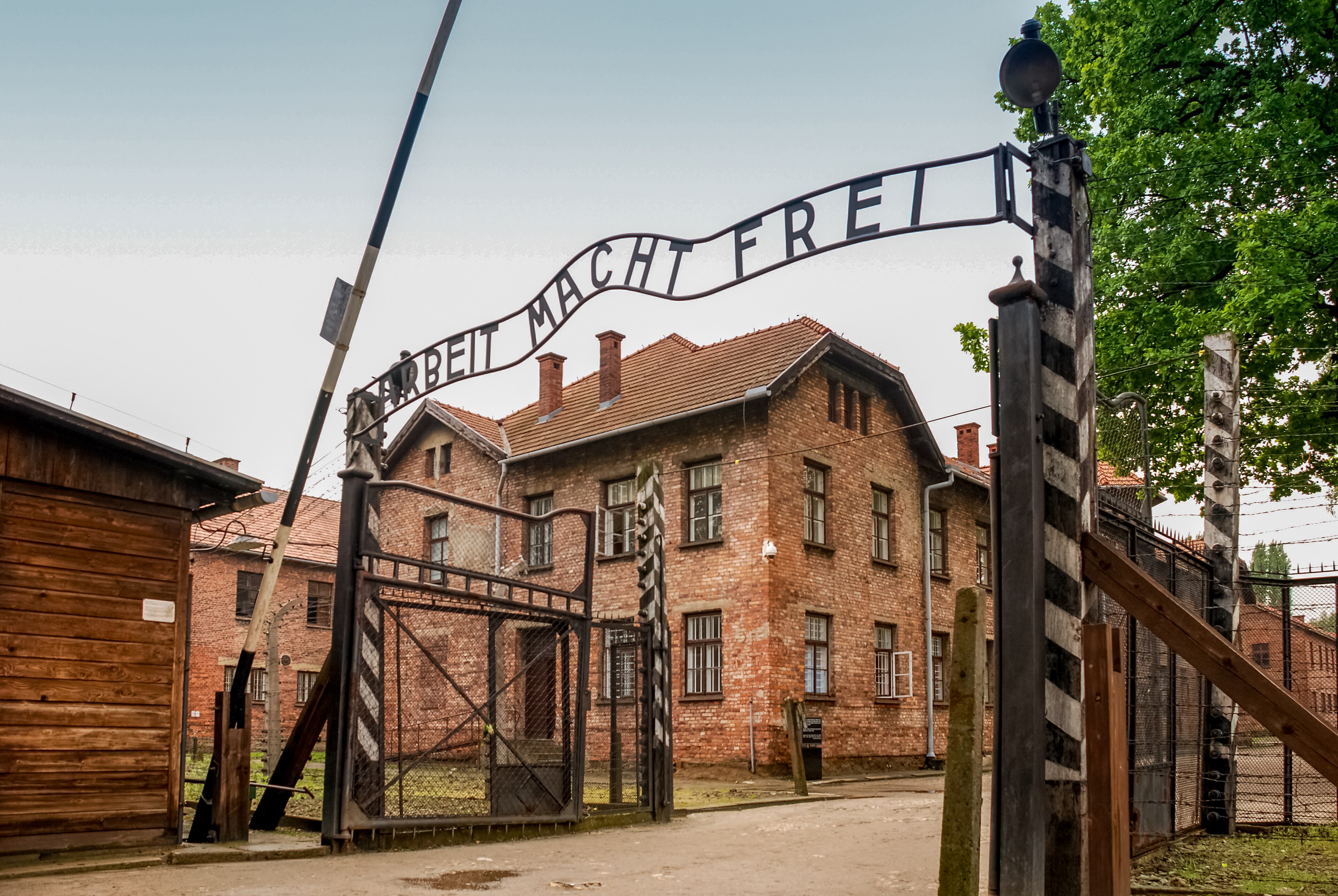
 50.0°N 20.0°E Occupied Europe
 The Holocaust
Briefing
The Nazi regime systematically murdered six million Jews, alongside Roma, Soviet prisoners of war, disabled people, and political enemies. What began with persecution and ghettoisation escalated to industrialised killing at purpose-built extermination camps. Its literature — diaries, survivor memoirs, and testimony — forms some of the most important writing of the twentieth century.
Books Covering This Event (37)
Memoir

A psychiatrist's memoir of Auschwitz and his development of logotherapy — finding meaning even in suffering.

A Polish-Jewish pianist's memoir of surviving the Warsaw Ghetto and hiding in the ruins of the city.

The diary of Anne Frank, a Jewish girl in hiding in Amsterdam during the Nazi occupation.

Primo Levi's account of his year in Auschwitz — a forensic examination of what the camp did to human identity.

Elie Wiesel's searing memoir of his experience as a teenager in Auschwitz and Buchenwald.

Hitler's architect and armaments minister writes from Spandau prison about life at the top of the regime.

A Dutch watchmaker's family hides Jews from the Gestapo, and pays for it in the camps.

Levi's final book — essays on memory, shame, and the grey zone of complicity in the camps, written forty years after Auschwitz.

A graphic novel depicting the Holocaust with Jews as mice and Nazis as cats, framed by the author's.

A ballerina sent to Auschwitz at sixteen — who danced for Mengele — becomes a psychologist and writes about freedom at ninety.
Academic
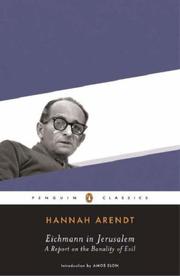
Arendt's report on the trial of Adolf Eichmann and her famous, furiously contested verdict: the banality of evil.

Seventy hours of prison interviews with Franz Stangl, commandant of Treblinka — ending days before his death.

How a battalion of middle-aged German policemen became mass murderers in Poland.

The final volume of Evans's trilogy: Germany at war, from the invasion of Poland to the ruins of Berlin.

Europe between Hitler and Stalin — fourteen million civilians murdered in the lands where both regimes ruled.

The complete history of the SS camp system, from the improvised cellars of 1933 to the death marches of 1945.
Historical Fiction

A novel of the Warsaw Ghetto Uprising, named for the bunker headquarters of the Jewish resistance.

Nine-year-old Anna's family flees Germany the day before the 1933 election, one step ahead of the Gestapo.

The sequel to The Winds of War carries the Henry family from Pearl Harbor through Midway, Leyte Gulf, and Auschwitz.

A young writer in postwar Brooklyn is drawn into the life of an Auschwitz survivor carrying an unbearable secret.

The documentary novel of Oskar Schindler, the Nazi profiteer who saved 1,200 Jews.

Ten-year-old Annemarie helps smuggle her Jewish best friend's family to Sweden during the rescue of the Danish Jews.

A German teenager's affair with an older woman returns to haunt him when she stands trial for war crimes.

Death narrates the story of a German girl, her foster family, and the Jewish man hidden in their basement.

The nine-year-old son of a camp commandant befriends a boy on the other side of the fence.

An SS intelligence officer narrates his own war — Babi Yar, Stalingrad, Auschwitz — with monstrous erudition and no remorse.

The Vél d'Hiv roundup of Paris's Jews in July 1942, told through a girl who locked her brother in a cupboard to save him.

Two parachutists are sent to kill Reinhard Heydrich, the architect of the Final Solution — while the author argues with himself about inventing any of it.

A New York socialite, a Polish prisoner, and a Nazi doctor — three women bound by the medical experiments at Ravensbrück.

One Polish-Jewish family scattered across continents by the war — based on the author's own family, all of whom survived.

Fourteen-year-old Dita guards the eight smuggled books of the camp's secret school in the Theresienstadt family block.

A novel based on the true story of Lale Sokolov, who tattooed prisoners' numbers at Auschwitz and fell in love there.

A Soviet Night Witch bomber pilot and a Nazi hunter converge on a war criminal hiding in postwar Boston.

A forger in occupied France encodes the real names of the Jewish children she documents into a single hidden book.

Popular History

The keepers of the Warsaw Zoo hide three hundred Jews in empty cages and their villa as the city burns around them.

Witold Pilecki volunteered to be imprisoned in Auschwitz — to build a resistance cell inside and smuggle out the truth.