 49.3°N 0.9°W Western Europe
 D-Day / Normandy Landings
Briefing
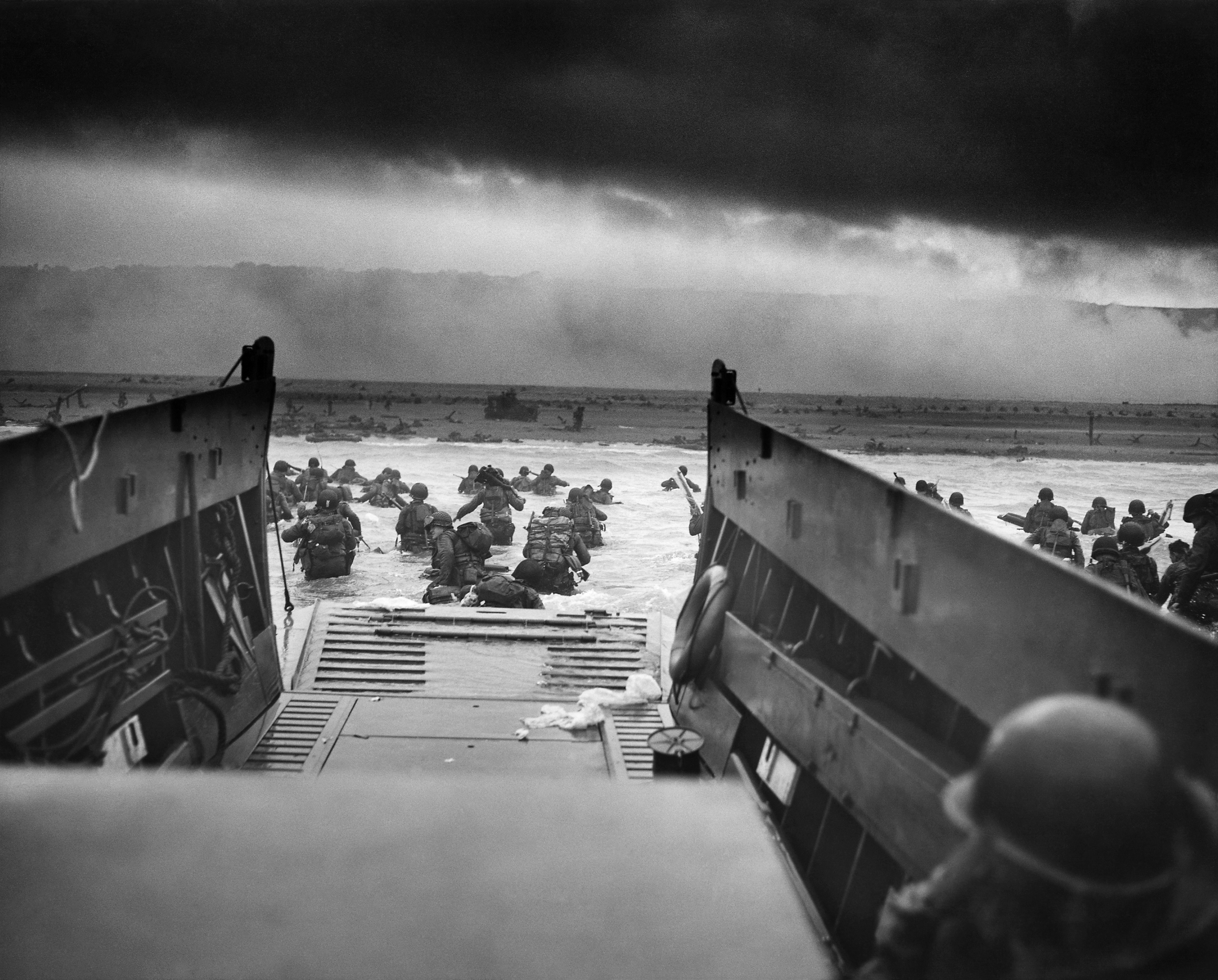
On 6 June 1944 some 156,000 Allied troops landed across five Normandy beaches, delivered by nearly 7,000 vessels in the largest amphibious operation ever mounted. The brutal weeks of fighting that followed in the bocage broke the German front in the West; Paris was liberated by the end of August.
Books Covering This Event (33)
Popular History

The classic account of D-Day told through the eyes of soldiers, officers, and civilians on both sides.

A monumental history of Nazi Germany from its origins through its destruction, written by a journalist who.

The liberation of Paris in August 1944 and Hitler's order to destroy the city.

The Normandy campaign told through six national armies — American, British, Canadian, Polish, French, and German.

A reappraisal of the Normandy campaign arguing that German soldiers were man-for-man superior to their Allied.

The glider assault that opened D-Day — six minutes past midnight, the first house in France liberated.

A single-volume history of the entire war by the most influential military historian of the 20th century.

The story of Easy Company, 506th PIR, from D-Day to Hitler's Eagle's Nest.

The American experience on D-Day, told through hundreds of oral histories from the men who fought.

The American soldier's experience from the Normandy beaches to the fall of Germany.

One Virginia town of 3,000 lost nineteen of its sons in the first minutes of Omaha Beach.

Eddie Chapman — safecracker, womaniser, and double agent — fakes sabotage for the Germans while working for MI5.

A comprehensive account of the Normandy invasion from the initial landings through the liberation of Paris.

A single-volume history of the war organised around one question: why did the Axis lose?

A global history of the war focused on the experience of ordinary people — soldiers and civilians — caught in.

The war of Felix Sparks and the 157th Infantry — from Sicily to Dachau.

The D-Day spies: how every German agent in Britain was turned, and an imaginary army aimed at Calais.

The final volume of the Liberation Trilogy: from D-Day to the fall of the Third Reich.

The women of SOE parachuted into France to arm the Resistance ahead of the invasion.
Academic

A revolutionary study comparing combat experience at Agincourt, Waterloo, and the Somme.

The standard one-volume academic history of the entire global war.

An analytical answer to the war's biggest question — production, technology, morale, and the sea lanes.
Memoir

Pyle's dispatches from Sicily, Italy, and Normandy — the war at the level of one tired man at a time.

Churchill's six-volume memoir-history of the entire war, from the gathering storm to triumph and tragedy.

The Supreme Commander's own account of the war in the West, from Torch to the German surrender.

The Desert Fox's own campaign narratives and letters, recovered after his forced suicide and edited by Liddell Hart.

A replacement infantry officer from Normandy to the Bulge — of his original company, almost no one else lasted.

SOE's 22-year-old codemaster fights to replace poem codes that were killing his agents — including the one he wrote for the girl he loved.

Easy Company's commander tells his own story — Brécourt Manor, Bastogne, and the burden of leading men you love.

Oral histories from German soldiers who defended the Normandy beaches on June 6, 1944.
Historical Fiction

Three soldiers — two American, one German — converge across the whole war toward a single clearing in Bavaria.

A blind French girl and a German boy's paths converge in occupied Saint-Malo during the Allied bombardment.

The War in Books: D-Day
The most-written day of the war, read through the book that assembles it and the book that interrogates it.
No day of the war has been written about more than the sixth of June, 1944, and that is itself a problem worth starting with. When a single morning has been filmed, novelised, memorialised, and re-fought on screen so many times that its images arrive in your head before any book can, the writer’s task is not to describe D-Day — you have seen it — but to make you feel how little those images actually tell you. Two books do this, and they do it in opposite directions, which is why they belong together. Cornelius Ryan’s The Longest Day pulls the camera back until you can see the whole vast machine of the invasion. John Keegan’s The Face of Battle pushes it so close that the machine disappears and you are left with the only thing that was ever really there: a frightened man, on a specific patch of sand, trying to stay alive.
Ryan’s book, published in 1959, was a feat of assembly before it was a feat of prose. He tracked down more than a thousand survivors — Allied and German, generals and privates, French civilians who woke to find the war had landed in their fields — and braided their testimony into a single propulsive narrative of the twenty-four hours. The effect is panoramic and humane at once: you are everywhere along the invasion front, and yet the war keeps narrowing to one man’s small experience of it before widening again. It is the definitive journalistic account of the invasion, and did as much as any book to popularise the “you are there” history that followed.
It is worth remembering how the planners themselves spoke of the thing, before it became legend. The order that launched it carried none of the grandeur later hung upon the day; it was the flat, deliberate prose of men managing risk:
You are about to embark upon the Great Crusade, toward which we have striven these many months. The eyes of the world are upon you.
— General Dwight D. Eisenhower, Order of the Day, 6 June 1944
Eisenhower wrote a second message that same day and put it in his wallet, to be released if the landings failed: a short note taking, in advance, the entire blame upon himself. He never had to send it. The juxtaposition of those two texts — the public exhortation and the private confession of possible catastrophe — tells you more about command on the eve of D-Day than any description of the beaches could, and it is the kind of thing the documentary record, dry as it is, preserves better than memory does.
What makes The Longest Day endure is not its scale alone but the way Ryan refuses to let scale become abstraction. The book is built from small, exact human moments, each one drawn from a living mouth: the paratrooper who came down in the wrong field and spent the night alone; the German officer who could not get anyone at headquarters to believe the invasion had begun; the men of the first waves who watched the ramps drop and understood, in the half-second before the machine guns found them, exactly what was about to happen. Ryan had a journalist’s distrust of the grand summary, and so the day arrives not as History but as a thousand particular fears, which is how it was actually lived. He also did something quietly radical for a 1959 book about the war: he gave the German soldiers faces and voices, let them be tired and frightened and human, and in doing so made the invasion a tragedy with two sides rather than a triumph with one. That choice is part of why the book has aged so well while more triumphant accounts have curdled.
Where Ryan assembles the day, Keegan interrogates it. The Face of Battle, published in 1976, is not really a book about D-Day at all — it is a book about how we lie when we write about battle, using Agincourt, Waterloo, and the Somme as its cases, and it changed military history permanently by asking a child’s question that no one had properly answered: what is it actually like? What happens to a body struck by a bullet. What a man can and cannot see through smoke and fear. Why men stay in the line at all when every instinct screams at them to run. Keegan noticed that the traditional “battle piece” — the historian’s clean account of units moving across a map like chess pieces — was a kind of genteel fiction, written from the general’s vantage and erasing the only perspective that mattered, which was that of the man being shot at.
Applied to the twentieth century, Keegan’s method strips the heroism and the strategy away and leaves the physical, terrifying particularity of combat. He is interested in the things other historians find unseemly: the deafening confusion, the way a unit’s “advance” is in reality a scatter of individual men each making private calculations about cover and survival. He wants to know what the ground was like underfoot, what the noise did to the mind, how a nineteen-year-old made his legs carry him forward off a landing ramp into fire. None of this appears on the operational maps. All of it is what the day actually consisted of.
Read the two together and each completes the other. Ryan gives you the whole — the breathtaking logistical fact of the largest amphibious invasion in history, the careful choreography of airborne drops and naval bombardment and the tides. Keegan reminds you that the whole was made entirely of the smallest unit imaginable: one man’s body and one man’s terror, repeated many thousands of times. Hold both in your head at once and you have something close to the truth of the day, which is that it was simultaneously a triumph of industrial planning and a morning of private, individual horror, and that those two facts do not cancel but compound each other. The planning is more awesome, not less, when you grasp what it asked of the men at the end of it; the men’s courage is more extraordinary, not less, when you see the vast machine that delivered them to the sand.
This is the deeper reason the films, for all their power, mislead. A camera, even at its most visceral, is still a vantage outside the man — you watch the soldier fall. Ryan and Keegan, between them, put you inside: Ryan inside the day’s human texture, Keegan inside the body’s experience of violence. Once you have read them, the famous images do not become false, but they become insufficient in a way you cannot un-feel. You know what they are leaving out.
The sixth of June was not the end of anything; the war in the west had eleven more months to run, and some of its worst was still ahead, in the hedgerows beyond the beaches and the winter forests further on. But it was the day the outcome stopped being in serious doubt, and it earned its place in memory honestly. What Ryan and Keegan teach, each in his way, is that the honouring of such a day is not done by making it grander than it was. It is done by making it truer — by insisting, against the pull of the legend, on the frightened particular men who were actually there.