 50.0°N 2.7°E Western Front
Battle of the Somme
Briefing
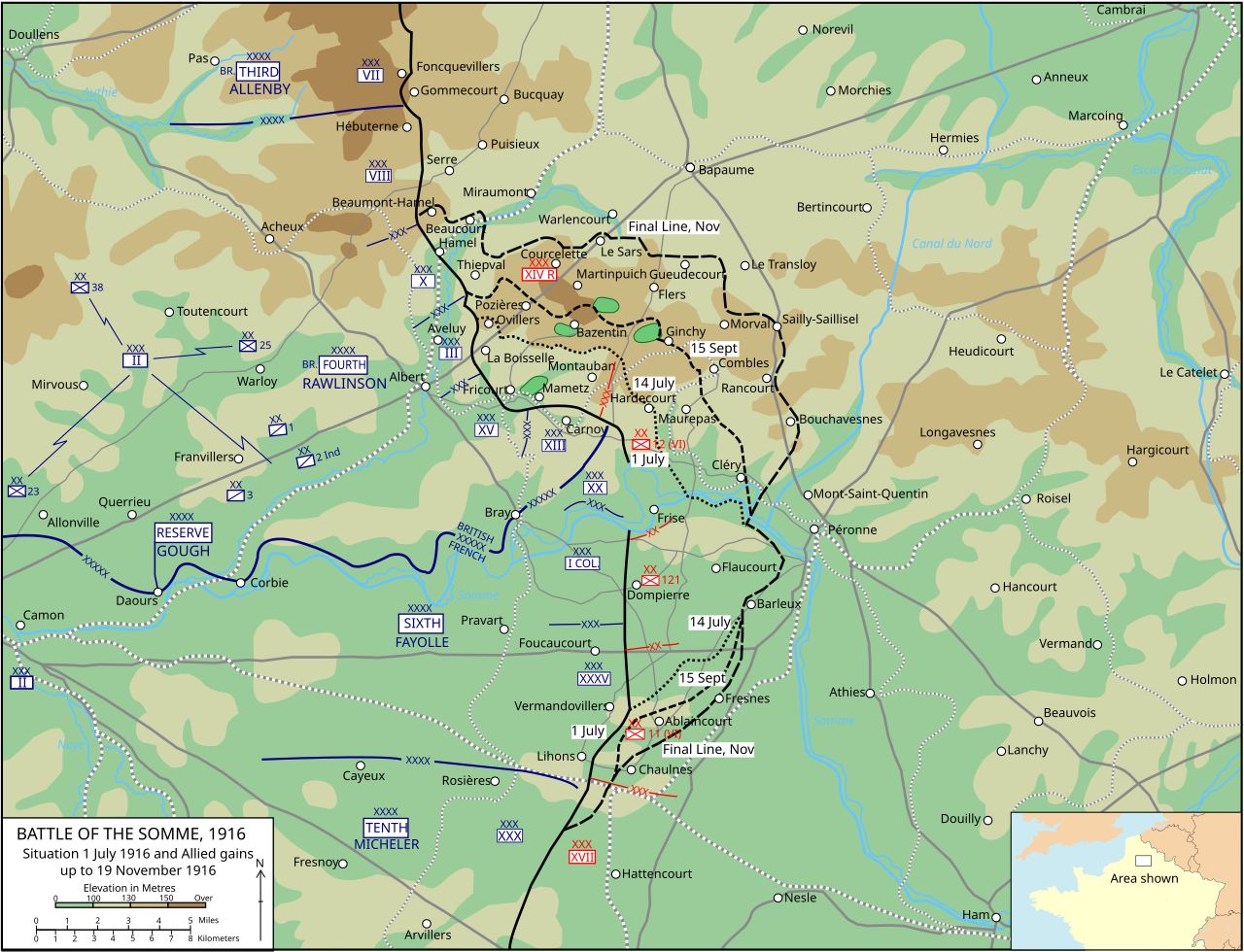
On 1 July 1916 the British Army suffered 57,470 casualties — the bloodiest day in its history — in the opening hours of the Somme offensive. The battle ground on until November for a few miles of mud, costing over a million casualties on all sides and becoming the enduring symbol of the war's industrial slaughter. It also saw the first use of the tank.
Books Covering This Event (11)
Historical Fiction

A young German soldier and his classmates are destroyed, body and soul, by the trenches of the Western Front.

A novel of love and war that follows an Englishman from a pre-war affair into the tunnels and trenches of the Somme.
Memoir

A German stormtroop officer's diary-based account of four years in the trenches, from 1915 to 1918.

A poet's quietly devastating memoir of two years in the line at the Somme and Ypres.

Robert Graves's bitter, blackly comic memoir of his upbringing and his service as an infantry officer on the Western Front.

The lightly fictionalised memoir of an officer's journey from eager patriotism through the Somme to open protest against the war.

Vera Brittain's memoir of nursing the wounded while the war killed her fiancé, her brother, and her closest friends.
Popular History

A single-volume military history of the entire war by the most influential military historian of the 20th century.

A global history of the war that ranges far beyond the Western Front to Africa, the Middle East, and the seas.

An intimate history of the war told through the diaries and letters of twenty ordinary people on every front.

A history of the war in Britain told through both those who fought it and those who refused to.
This Event on Screen
Screen adaptations of books on this page, each linked to the book it came from: All Quiet on the Western Front (2022).
The War in Books: The Somme
The first day has come to stand for the whole war, and the writers who were there are why.
More than any other battle, the Somme belongs to its writers. Much of what English readers believe about the First World War comes from a small group of memoirists and poets who served in it. Robert Graves was so badly wounded on the Somme that his family was told he had died, and Goodbye to All That turns that experience into something bitter and blackly funny. Siegfried Sassoon’s Memoirs of an Infantry Officer traces the path from keen front-line officer to public protest. Vera Brittain’s Testament of Youth reminds readers that the war’s losses extended well beyond the men in the line.
German voices complicate this picture. Ernst Jünger’s Storm of Steel offers no disillusion at all: it is cold, exact and disturbingly exhilarated, and should be read alongside Remarque’s All Quiet on the Western Front, its moral opposite. Among novels, Sebastian Faulks’s Birdsong brought the first day of the Somme to a new generation of readers. Historians have since questioned whether the memoirs tell the whole story, since the battle also taught the British army hard lessons it used in 1918. But the memoirs have outlasted every revision, because they record what the mapped lines of attack leave out.