 55.8°N 37.6°E Eastern Front
Operation Barbarossa
Briefing
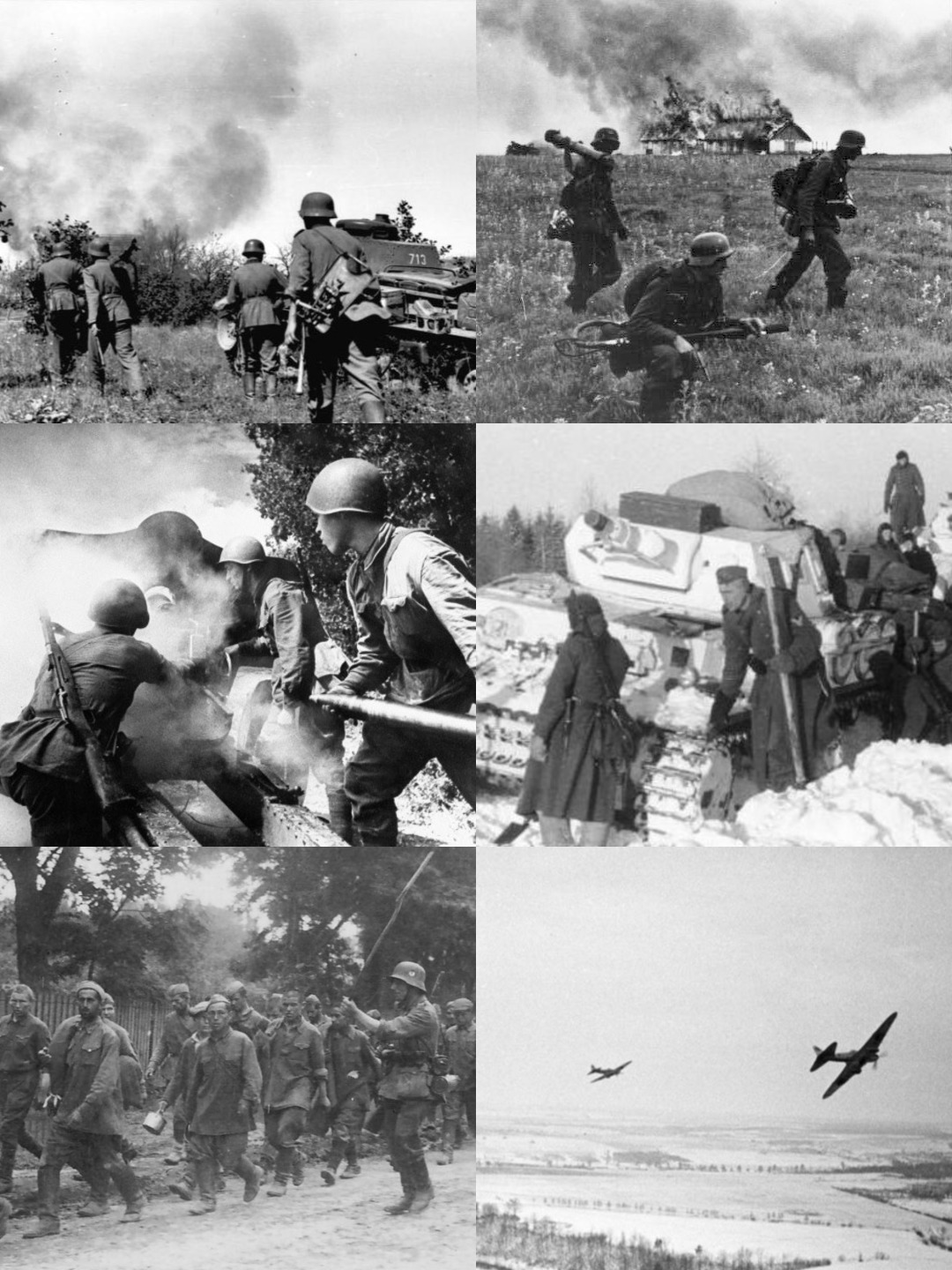
On 22 June 1941 nearly four million Axis troops invaded the Soviet Union along an 1,800-mile front — the largest invasion in human history. German spearheads reached the gates of Moscow by December before being thrown back by the Soviet winter counteroffensive. The Eastern Front it opened would consume roughly eight of every ten German soldiers killed in the war.
Books Covering This Event (19)
Popular History

A monumental history of Nazi Germany from its origins through its destruction, written by a journalist who reported from Hitler's Berlin.

The BBC's Moscow correspondent, who spent the entire war in the USSR, writes the inside account of the Soviet war effort.

A single-volume history of the entire war by the most influential military historian of the 20th century.

The life and death of the ordinary Red Army soldier, from the catastrophe of 1941 to Berlin.

A single-volume history of the war organised around one question: why did the Axis lose?

A global history of the war focused on the experience of ordinary people — soldiers and civilians — caught in it.
Memoir

The architect of blitzkrieg recounts Poland, France, and the drive on Moscow — and his quarrels with Hitler.

A young Alsatian conscript's memoir of the Wehrmacht on the Eastern Front, 1942–1945.

An oral history of the million Soviet women who fought — snipers, pilots, tank drivers, medics — in their own voices.

A German officer's war from Czechoslovakia to the bunker — he briefed Hitler in the final days, then spent five years in Soviet captivity.
Academic

The standard one-volume academic history of the entire global war.

The Eastern Front from the Soviet side, by the Western historian who did most to open the Red Army archives.

The making and breaking of the Nazi economy — the war explained through fuel, steel, grain, and labor.

The final volume of Evans's trilogy: Germany at war, from the invasion of Poland to the ruins of Berlin.

Europe between Hitler and Stalin — fourteen million civilians murdered in the lands where both regimes ruled.

Historical Fiction

An SS intelligence officer narrates his own war — Babi Yar, Stalingrad, Auschwitz — with monstrous erudition and no remorse.

A Soviet Night Witch bomber pilot and a Nazi hunter converge on a war criminal hiding in postwar Boston.

Lyudmila Pavlichenko, history's deadliest female sniper with 309 kills, is sent from the Sevastopol trenches to tour America with Eleanor Roosevelt.
The War in Books: Operation Barbarossa
The largest invasion ever launched, and a war of annihilation from its first day.
Barbarossa was never a conventional campaign, and the essential books on it make that plain. Adam Tooze’s The Wages of Destruction shows how the attack grew from Nazi economic logic: a regime in need of grain, oil and land, prepared to let millions starve to get them. Timothy Snyder’s Bloodlands widens the frame to the lands between Berlin and Moscow, where the two regimes together deliberately killed some fourteen million people. These books change how the invasion reads. It stops looking like a military gamble that went wrong and starts looking like a programme of mass murder that happened to need an army.
William Shirer and Ian Kershaw are the guides to the German decisions, and Max Hastings’s Inferno keeps the human cost in view. Svetlana Alexievich’s The Unwomanly Face of War offers something none of them can: the voices of Soviet women who fought, gathered decades later, against an official memory that left them out. Alexievich won the Nobel Prize in Literature in 2015, and this book shows why. Read Tooze and Snyder for why the war was fought as it was, and Alexievich for what it was to live through.