 32.9°N 13.2°E North Africa
North Africa Campaign
Briefing
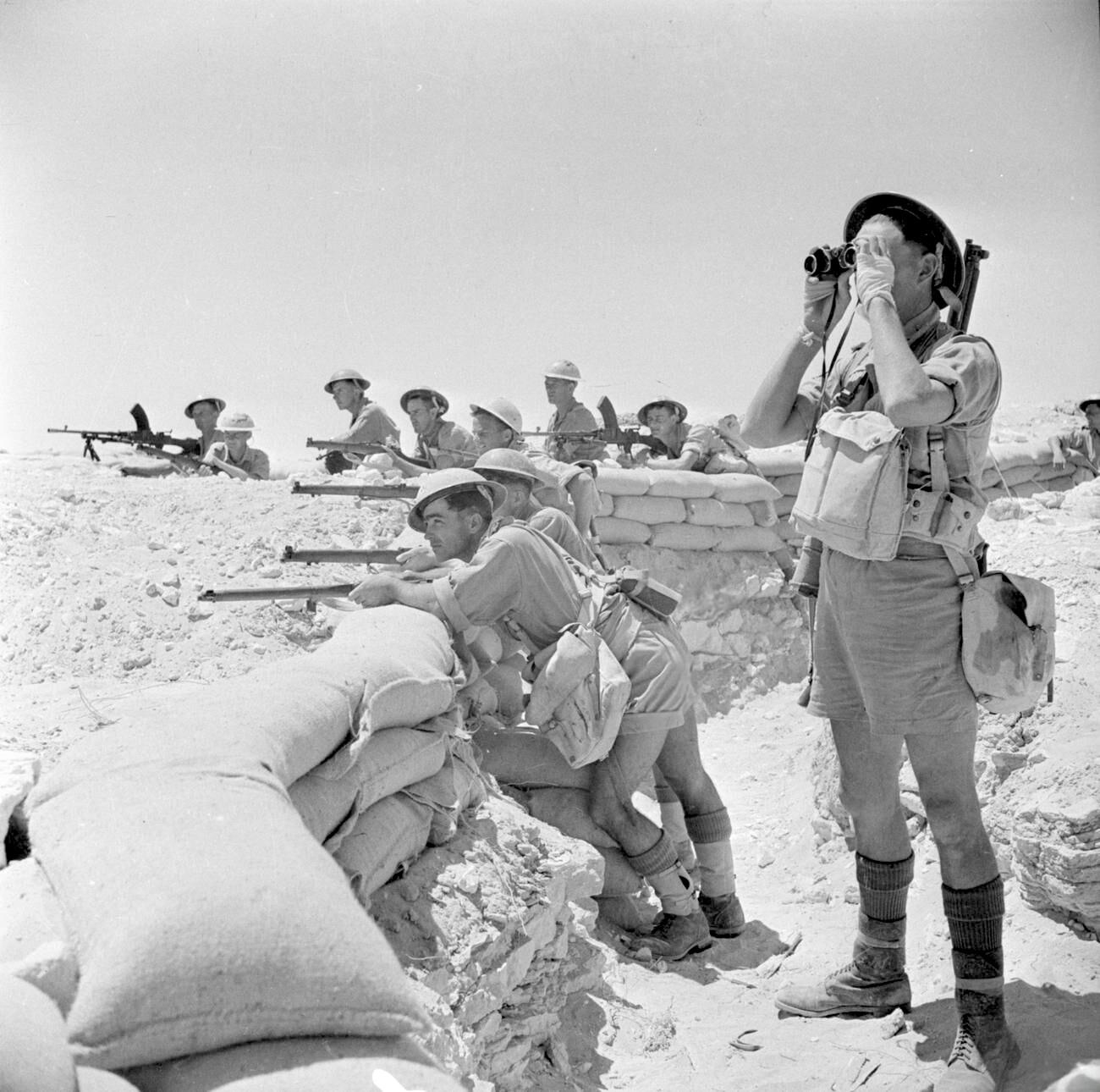
From 1940 to 1943 the desert war swung back and forth across Libya and Egypt as Rommel's Afrika Korps duelled the British Eighth Army over supply lines and oil. The British victory at El Alamein in late 1942 and the Anglo-American Torch landings caught the Axis in a vice, ending with the surrender of over 250,000 Axis troops in Tunisia in May 1943 — the US Army's first hard schooling against the Wehrmacht.
Books Covering This Event (7)
Popular History

The first volume of the Liberation Trilogy, covering the US Army's education in North Africa.

The authorized history of the SAS — misfits and poets blowing up airfields behind Rommel's lines.
Memoir

Pyle's first collection — the green American army learning war in the North African desert.

The Supreme Commander's own account of the war in the West, from Torch to the German surrender.

The Desert Fox's own campaign narratives and letters, recovered after his forced suicide and edited by Liddell Hart.
Historical Fiction

Three soldiers — two American, one German — converge across the whole war toward a single clearing in Bavaria.

A burned man in a ruined Italian villa, a Canadian nurse, a Sikh sapper, and a thief — four lives wrecked by the desert war.
The War in Books: North Africa
A war of supply lines and open desert, where the American army learned its trade.
The desert war has a reputation for being cleaner than other campaigns, and the reputation is mostly undeserved. It was a contest of logistics fought across huge distances, in which an army’s fate depended on how far it was from its fuel. For the British it was the long struggle against Rommel; for the Americans, arriving with Operation Torch in November 1942, it was a hard and sometimes embarrassing education.
Rick Atkinson’s An Army at Dawn, which won the Pulitzer Prize, tells that second story and is the best single account of how an inexperienced army became a capable one. Ernie Pyle’s Here Is Your War shows the same process from the ground, in the voice of the reporter who made the common soldier his subject. Ben Macintyre’s SAS: Rogue Heroes tells the origin of the Special Air Service as a story of misfits raiding behind the lines. Fiction reaches further still: Michael Ondaatje’s The English Patient, set in an Italian villa in 1945, reaches back to the pre-war desert and its explorers in a meditation on loss and national belonging, and Irwin Shaw’s The Young Lions includes the campaign in its sweep. Start with Atkinson, and keep Pyle close by.