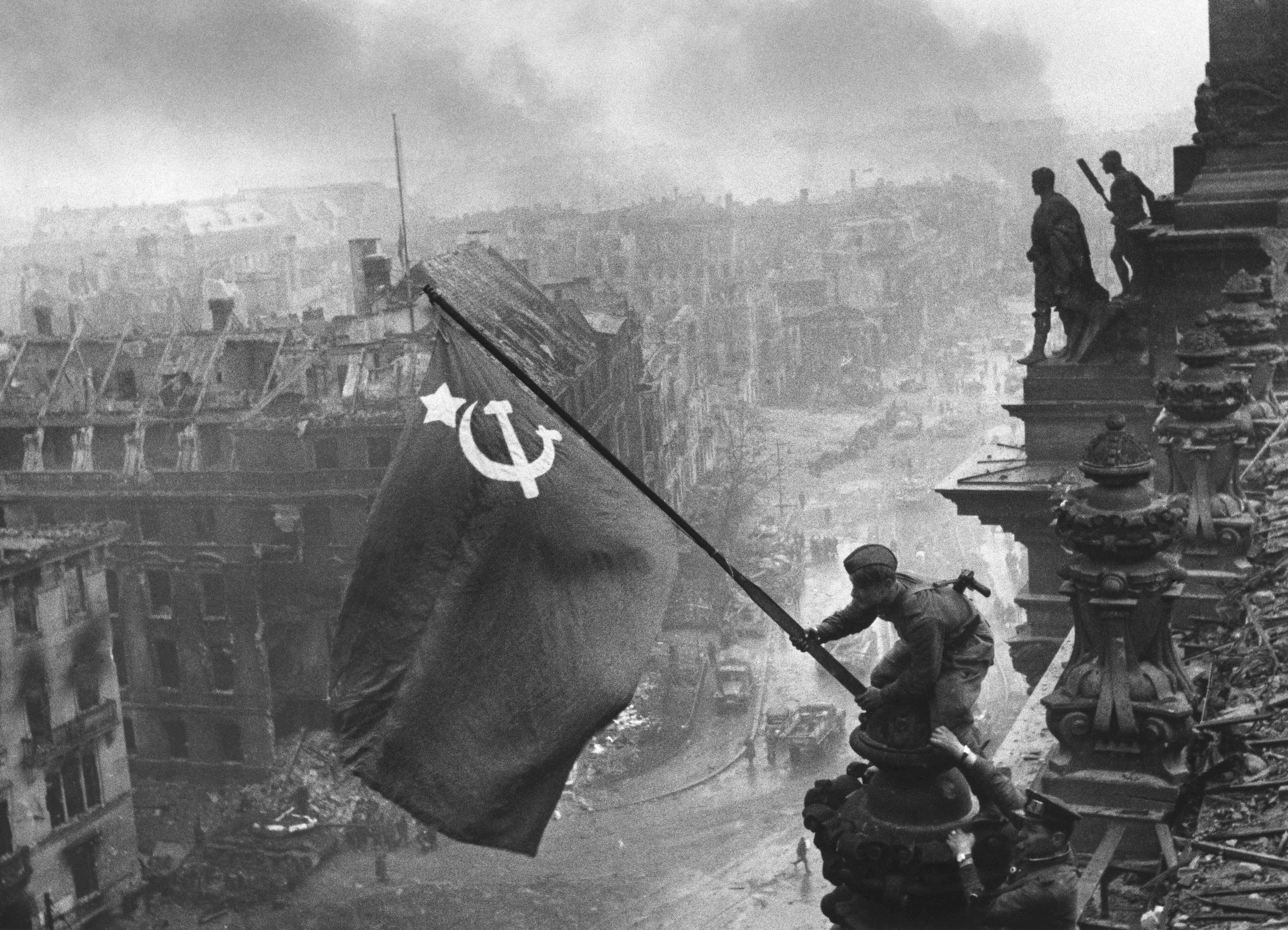
 52.5°N 13.4°E Central Europe
Fall of Berlin
Briefing
From 16 April 1945, 2.5 million Soviet troops fought their way into the capital of the Third Reich street by street. Hitler killed himself in his bunker on 30 April; the city garrison capitulated on 2 May; and the war in Europe ended six days later. Roughly 80,000 Soviet soldiers died taking the city.
Books Covering This Event (26)
Popular History

The British intelligence officer sent to establish Hitler's fate reconstructs the final days in the bunker.

A monumental history of Nazi Germany from its origins through its destruction, written by a journalist who reported from Hitler's Berlin.

The BBC's Moscow correspondent, who spent the entire war in the USSR, writes the inside account of the Soviet war effort.

The race for Berlin told from American, Soviet, German military, and civilian perspectives.

A single-volume history of the entire war by the most influential military historian of the 20th century.

The story of Easy Company, 506th PIR, from D-Day to Hitler's Eagle's Nest.

The American soldier's experience from the Normandy beaches to the fall of Germany.

The apocalyptic final battle of the European war, from the Soviet advance to Hitler's bunker.

The final battle for Germany on both fronts, from September 1944 to the surrender.

The life and death of the ordinary Red Army soldier, from the catastrophe of 1941 to Berlin.

A single-volume history of the war organised around one question: why did the Axis lose?

A global history of the war focused on the experience of ordinary people — soldiers and civilians — caught in it.

Europe in the years immediately after the war — vengeance, ethnic cleansing, famine, and lawlessness.

The final volume of the Liberation Trilogy: from D-Day to the fall of the Third Reich.
Memoir

Churchill's six-volume memoir-history of the entire war, from the gathering storm to triumph and tragedy.

The Supreme Commander's own account of the war in the West, from Torch to the German surrender.

An anonymous German woman's diary of the Soviet conquest of Berlin and the mass sexual violence that followed.

A young Alsatian conscript's memoir of the Wehrmacht on the Eastern Front, 1942–1945.

Hitler's architect and armaments minister writes from Spandau prison about life at the top of the regime.

An oral history of the million Soviet women who fought — snipers, pilots, tank drivers, medics — in their own voices.

A German officer's war from Czechoslovakia to the bunker — he briefed Hitler in the final days, then spent five years in Soviet captivity.

Grossman's wartime notebooks as a Red Army correspondent, edited by Antony Beevor — Stalingrad, Kursk, Treblinka, Berlin.
Academic

The Eastern Front from the Soviet side, by the Western historian who did most to open the Red Army archives.

The final volume of Evans's trilogy: Germany at war, from the invasion of Poland to the ruins of Berlin.


This Event on Screen
Screen adaptations of books on this page, each linked to the book it came from: Band of Brothers (2001).
The War in Books: The Fall of Berlin
The last great battle in Europe, from the bunker, the Red Army and the cellars.
Antony Beevor’s The Fall of Berlin 1945 is the standard popular account, and it covers both the end of the Third Reich and the Soviet conquest, including the mass rapes that accompanied it. That last subject was long treated with silence, and its most important witness is a woman, long known only as Anonymous, whose diary, A Woman in Berlin, records the weeks in which the city fell and was occupied. Its first German-language publication was badly received, and it found its full readership only decades later. It is one of the most remarkable documents of the war, cool and exact about matters most writers could not face.
Vasily Grossman’s A Writer at War shows the same days from the side of the Red Army, by a correspondent who had been with it since 1941 and had seen what the Germans left behind them. Svetlana Alexievich’s The Unwomanly Face of War adds the voices of Soviet women who served with the Red Army. Ian Kershaw’s Hitler and William Shirer’s The Rise and Fall of the Third Reich provide the end of the bunker story. These books do not tell a tidy story of liberation, which is their value. Reading Beevor and the anonymous diary together shows the fall of Berlin as both a just defeat and a human catastrophe.