 52.2°N 21.0°E Eastern Europe
Invasion of Poland
Briefing
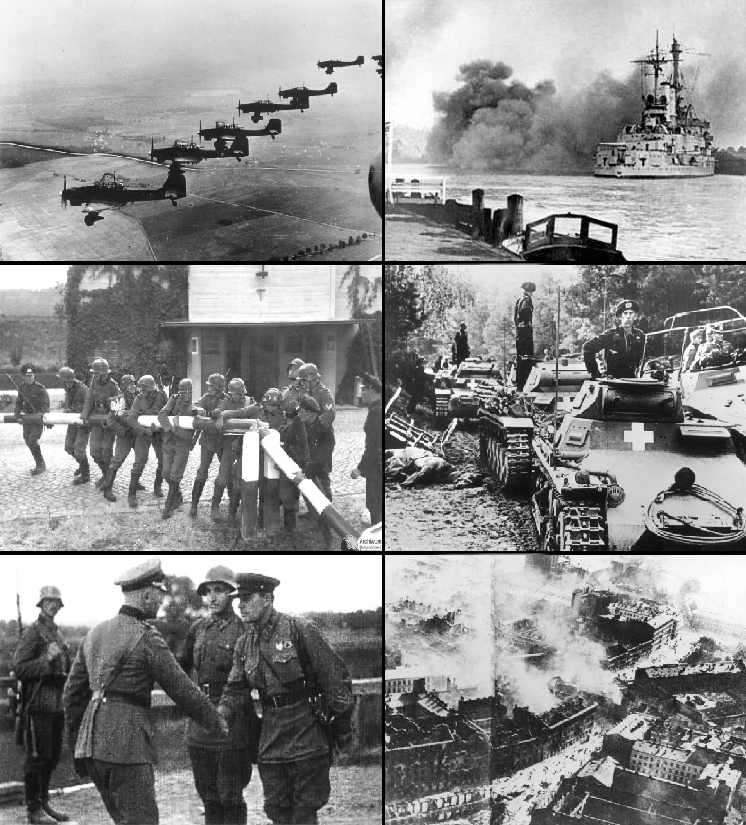
Germany invaded Poland on 1 September 1939 with 1.5 million troops in the first full demonstration of blitzkrieg warfare, and the Soviet Union invaded from the east two weeks later under the secret terms of the Molotov-Ribbentrop Pact. Britain and France declared war on 3 September, but Poland was partitioned within five weeks. The occupation that followed would kill nearly one fifth of the Polish population.
Books Covering This Event (13)
Popular History

A monumental history of Nazi Germany from its origins through its destruction, written by a journalist who reported from Hitler's Berlin.

A single-volume history of the entire war by the most influential military historian of the 20th century.

A single-volume history of the war organised around one question: why did the Axis lose?

A global history of the war focused on the experience of ordinary people — soldiers and civilians — caught in it.
Memoir

Shirer's actual diary as CBS correspondent in Berlin, from the Anschluss to the fall of France — published while the war still hung in the balance.

A Polish-Jewish pianist's memoir of surviving the Warsaw Ghetto and hiding in the ruins of the city.

Churchill's six-volume memoir-history of the entire war, from the gathering storm to triumph and tragedy.

The architect of blitzkrieg recounts Poland, France, and the drive on Moscow — and his quarrels with Hitler.

Academic

The standard one-volume academic history of the entire global war.

The making and breaking of the Nazi economy — the war explained through fuel, steel, grain, and labor.

The final volume of Evans's trilogy: Germany at war, from the invasion of Poland to the ruins of Berlin.

This Event on Screen
Screen adaptations of books on this page, each linked to the book it came from: The Pianist (2002).
The War in Books: The Invasion of Poland
Five weeks in 1939, and an occupation that outlasted almost everything that followed.
General histories tend to pass through September 1939 quickly on their way to the fall of France. That is misleading, because Poland’s war did not end when its army was defeated. The country was divided between Germany and the Soviet Union, and what followed was among the most savage occupations of the war. The invasion is best understood as the start of something rather than a short campaign that came before the real fighting.
For the strategy behind it, William Shirer’s The Rise and Fall of the Third Reich remains the great narrative, and Ian Kershaw’s Hitler shows how the decision for war was taken. Adam Tooze’s The Wages of Destruction adds a harder-edged argument: the Nazi economy was under great strain, and that strain helped set the timing and the logic of expansion. Max Hastings’s Inferno keeps sight of ordinary people caught in the disaster. But the book that stays with most readers is Władysław Szpilman’s The Pianist, the memoir of a Polish-Jewish musician who survived in the ruins of Warsaw. It shows what occupation meant for a single person in a single city, which the histories, for all their reach, cannot.