 48.7°N 44.5°E Eastern Front
Battle of Stalingrad
Briefing
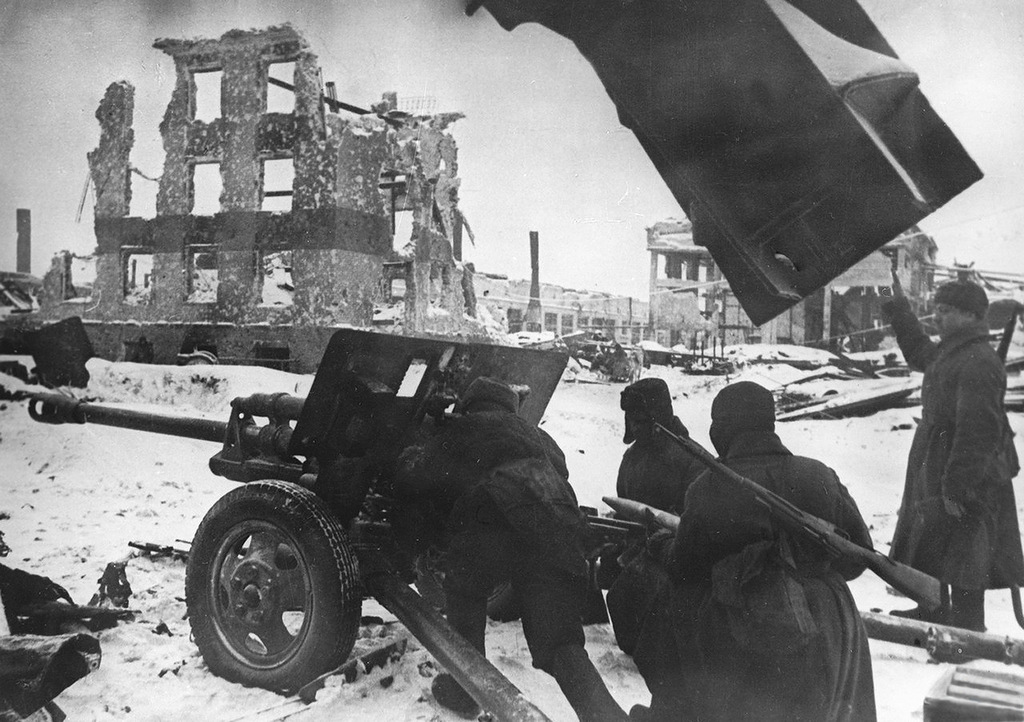
From August 1942 to February 1943 the fight for Stalingrad consumed nearly two million casualties in house-to-house combat the Germans called Rattenkrieg — rat war. The Soviet encirclement of November 1942 trapped the entire German Sixth Army; roughly 91,000 starving survivors surrendered in February, of whom only a few thousand ever returned home. It was the turning point of the war in Europe.
Books Covering This Event (16)
Popular History

A monumental history of Nazi Germany from its origins through its destruction, written by a journalist who reported from Hitler's Berlin.

The BBC's Moscow correspondent, who spent the entire war in the USSR, writes the inside account of the Soviet war effort.

The battle for Stalingrad told through hundreds of interviews with survivors on both sides.

A single-volume history of the entire war by the most influential military historian of the 20th century.

The definitive account of the Battle of Stalingrad, drawing on Soviet archives opened after the Cold War.

The life and death of the ordinary Red Army soldier, from the catastrophe of 1941 to Berlin.

A single-volume history of the war organised around one question: why did the Axis lose?

A global history of the war focused on the experience of ordinary people — soldiers and civilians — caught in it.
Memoir

A young Alsatian conscript's memoir of the Wehrmacht on the Eastern Front, 1942–1945.

An oral history of the million Soviet women who fought — snipers, pilots, tank drivers, medics — in their own voices.

A Wehrmacht machine-gunner's secret notes from Stalingrad and the long retreat, hidden for fifty years.

Grossman's wartime notebooks as a Red Army correspondent, edited by Antony Beevor — Stalingrad, Kursk, Treblinka, Berlin.
Historical Fiction

The prequel to Life and Fate — the Shaposhnikov family as the German tide reaches the Volga — finally published uncensored in 2019.

The War and Peace of the twentieth century — one extended family swept through Stalingrad, the Gulag, and the Shoah.

An SS intelligence officer narrates his own war — Babi Yar, Stalingrad, Auschwitz — with monstrous erudition and no remorse.

This Event on Screen
Screen adaptations of books on this page, each linked to the book it came from: Life and Fate (2012), Enemy at the Gates (2001).
The War in Books: Stalingrad
One city, and a novel that argues with everything around it.
Antony Beevor’s Stalingrad is the book that made the battle a popular subject again in the English-speaking world. Published in 1998, it draws on archives that had opened after the Cold War, and it is unsparing about what both armies did to their own men as well as to each other. It is the natural first read. Vasily Grossman’s notebooks, published as A Writer at War and edited by Beevor and Luba Vinogradova, take you closer. Grossman was a Soviet correspondent who reported from the city during the fighting, and his notes record what he saw before any official version had set.
From those experiences came Life and Fate, the novel often called the War and Peace of the twentieth century. The Soviet authorities suppressed it in the early 1960s, and it was published in the West only long after Grossman’s death. It is about far more than the battle: it sets the defence of Stalingrad beside the Gulag and the Holocaust, and it dares to compare the two regimes that fought there. That comparison is a large part of why it was banned, and why it matters. Svetlana Alexievich’s The Unwomanly Face of War adds the women who fought. Begin with Beevor, but do not stop before Grossman, who is the reason this battle has a place in world literature.