 51.7°N 36.2°E Eastern Front
Battle of Kursk
Briefing
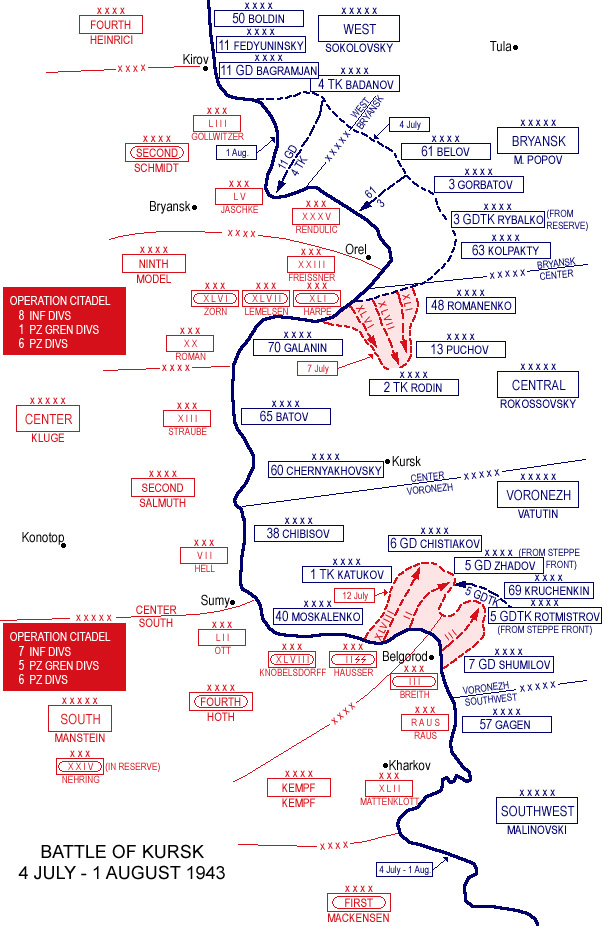
In July 1943 Germany threw its rebuilt panzer arm at the Kursk salient in Operation Citadel — the largest armored battle ever fought, involving some 8,000 tanks and assault guns. The Soviets knew it was coming and bled the offensive white in days. It was the last German strategic offensive in the East; from Kursk to Berlin the Red Army never stopped advancing.
Books Covering This Event (4)
Academic

The Eastern Front from the Soviet side, by the Western historian who did most to open the Red Army archives.

The definitive account of the largest tank battle in history, from both sides' archives.


The War in Books: Kursk
One of history’s greatest tank battles, and how the old story of it came apart.
For a long time Western readers understood the Eastern Front largely through the memoirs of German generals, who tended to blame Hitler, the weather and sheer Russian numbers for their defeats. David Glantz did more than anyone to change that. When Titans Clashed, written with Jonathan House, tells the war from the Soviet side, using Soviet sources, and The Battle of Kursk, also with House, does the same for the great clash of July 1943. The latter is detailed and sometimes demanding, but it is the authoritative account, and it shows how carefully the Red Army prepared for an attack it knew was coming.
Two other books supply what operational history leaves out. Vasily Grossman’s wartime notebooks, A Writer at War, offer a correspondent’s view of the Red Army as it was turning the tide. Willi Heinrich’s novel Cross of Iron shows the other side of that shift: a German platoon in the retreats of 1943, as tired of its own officers as it is afraid of the enemy. Glantz gives the shape of the battle, and Heinrich and Grossman give the feel of what came after, when the initiative on the Eastern Front had passed for good and the long road west was opening.